

What makes an online quiz competition worthwhile: a big prize, or the chance to learn while you compete? Searching “online quiz competitions for students Nigeria” is a useful start, but the right choice depends on more than the headline. Check who can enter, what the questions cover, when the quiz takes place, and how scoring and rewards work.
Before the timer starts, you should know what to expect. This guide explains common quiz formats and how to compare entry requirements, schedules, and rules. You’ll also find practical ways to prepare for a timed quiz and use your result to choose what to revise next.
From individual rounds to quiz battles, a competition can make self-testing a more engaging part of your study routine. StudyPay.ng brings quiz battles together with curated past examination questions and study resources, giving you ways to practise and review. Choose an opportunity for its learning value and clear rules, not prizes alone, then take part with a plan.
Key Takeaways
- Use quizzes to practise recall, apply what you know, and notice which topics need more revision.
- Know the usual steps: read the rules, register, prepare, take the quiz, and review your result.
- When comparing online quiz competitions for students Nigeria, consider subject, level, schedule, rules, and learning value, not prizes alone.
- Prepare with focused revision and check your device, internet access, and timing before quiz day.
- StudyPay.ng quiz battles and study resources give students ways to practise across diverse academic topics.
What Are Online Quiz Competitions for Students in Nigeria?
An online quiz competition is an organised academic challenge that students complete through a digital platform. Questions may test recall, ask students to apply a concept, or combine both. Depending on the rules, participants may answer individually, compete against one another, or progress through several rounds. Quiz formats vary, as the general overview What is a Quiz? explains.
A quiz can be useful even when there is no prize. Answering without notes helps students practise recall, identify topics that need more work, and compare their performance across attempts. A score or leaderboard reflects performance in that particular session, not a student’s overall ability or likely academic results. Treat prizes as a possible feature, not the purpose of learning.
Which online quiz formats can students encounter?
Students may find open quizzes they can join individually, school-led contests for a class or school community, and organised competitions focused on a subject such as mathematics or science. Some cover a broad mix of school topics. A contest might have a timed qualifying round followed by another stage, or it might consist of one quiz session with no qualifier.
Check the subject coverage and format before signing up. A single-session quiz tests performance in one sitting. A multi-round contest may call for preparation on several dates. Find out whether students compete individually or in teams, how long they have to answer, and whether there are separate subject sections. Don’t assume two online quizzes follow the same format just because both use a screen and a timer.
Who can take part in student quiz competitions?
Some opportunities are intended for primary pupils, while others are aimed at secondary students or learners in tertiary institutions. Rules may specify a year of study, age range, institution type, or other entry conditions. Read these details before registering and match them to the student who plans to take part. If a competition is for a particular class level, a student outside that group may not be eligible.
A competition with national reach is not necessarily open to every student in Nigeria. It may welcome participants from across the country while limiting entry to a particular school level or subject group. Search results can help you find opportunities, but the organiser’s current announcement sets the eligibility, schedule, and format. For anyone searching “online quiz competitions for students Nigeria,” this is a useful first filter.
Keep the goal clear: choose a quiz that gives the student a suitable chance to practise and stretch their knowledge. Once you understand the format and entry conditions, it’s easier to follow the process and prepare with purpose.
Online Quiz Process: From Registration to Results
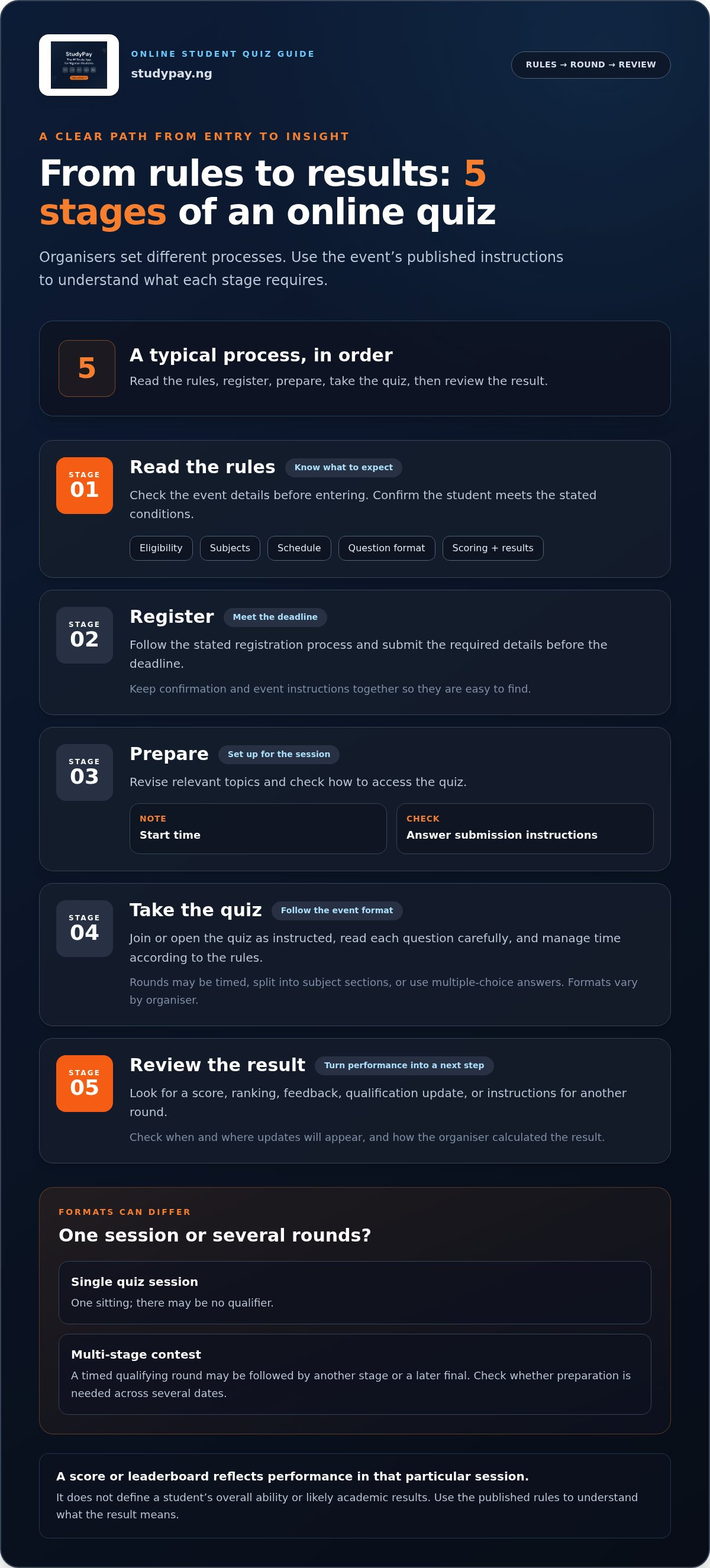
Each organiser sets its own process, so read the instructions for the specific event. A search for “online quiz competitions for students Nigeria” may lead to a single quiz session, a multi-stage contest, or a school-organised challenge. Note the key dates and requirements before you begin. A typical process looks like this:
- Read the rules. Check eligibility, subjects, schedule, question format, scoring, and how results will be shared. Confirm that the student meets the entry conditions.
- Register. Follow the stated process and submit the required details before the deadline. Keep any confirmation and event instructions together so they are easy to find.
- Prepare. Revise relevant topics and check how to access the quiz. Note the start time and instructions for submitting answers.
- Take the quiz. Open or join it as instructed, read each question carefully, and manage your time according to the rules.
- Review the result. Check for a score, ranking, feedback, or qualification update. If there is another round, note its instructions and schedule.
Some organisers use qualifying rounds, leaderboards, or a later final. Others run one quiz and share results afterward. A leaderboard shows relative performance, but the published scoring and qualification rules explain what the result means.
What happens during an online qualifier or quiz round?
A round might present timed questions, divide them into subject sections, or use multiple-choice answers. Students may complete it independently or take part in a scheduled event. Follow the instructions on when to start, how to move between questions, and how to submit answers. Don’t assume every event uses live video, the same time limit, or the same scoring method.
How can students understand scores and next steps?
After the quiz, an organiser may share scores, publish rankings, announce who qualifies, or provide feedback another way. Check the instructions for when and where updates will appear and how any next round will be communicated. To interpret a result, look at how it was calculated and what action, if any, follows.
The published rules are your guide from registration through results. Use them to understand what each stage requires and what your score means. For practice through academic challenges, StudyPay.ng quiz battles let students test their knowledge across diverse topics. Treat each attempt as a learning opportunity, then use what you notice to guide your next revision session.
How Can You Choose an Online Student Quiz Competition That Fits?
The biggest reward does not automatically make a competition the best fit. Look for an opportunity that matches the student’s level, supports a useful learning goal, and explains its rules clearly. A prize headline does not tell you whether the questions are relevant, the schedule works, or the student can participate comfortably.
Use these checks to compare online quiz competitions for students Nigeria. Give more weight to the published information than to promotional headlines.
Subject relevance
Ask: Does the quiz cover a subject the student wants to practise?
Good fit: The subject connects to current studies, revision needs, or genuine interests.
Student level and eligibility
Ask: Which ages, classes, schools, or institutions can enter?
Good fit: The stated criteria clearly match the participant.
Schedule and format
Ask: When is the quiz, how long does it run, and are there qualifiers or later rounds?
Good fit: The student can take part at the stated time and understands the format.
Scoring and qualification
Ask: How are answers scored, and what determines who advances?
Good fit: The organiser explains how scores, rankings, and qualification decisions work.
Privacy and rewards
Ask: What participant details are requested, and what do the reward terms say?
Good fit: Information about data use and any recognition or rewards is accessible and specific.
Do the subject, level, and format suit the student?
Start with the learner’s goal. A student revising a current school subject may get more relevant practice from a focused academic quiz than from a broad general-knowledge contest. Next, match the student’s age, class, or institution to the entry requirements. Consider the format too: a timed quiz may suit a student who has practised answering under time pressure, while another student may want to build confidence through regular self-testing first.
Are the rules, recognition, and rewards clearly explained?
Before registering, find the information on scoring, deadlines, result announcements, and later rounds. Read the privacy information to understand what details are requested and how the organiser says they will be used. Distinguish academic recognition and participation incentives from claims that suggest guaranteed income. A reward should not be treated as certain unless the published terms explain what qualifies and how it is awarded.
A credible competition explains eligibility, scoring, and rewards before participation. If important details are difficult to find, read the organiser’s complete, current rules before deciding. Then choose an option that gives the student a clear reason to participate, whether that is practising a subject, testing recall, or gaining experience with a timed quiz. The learning can be worthwhile regardless of the final ranking.
How Should Students Prepare for an Online Quiz Competition?
Confidence comes from preparation, not cramming. A simple plan helps you focus on what you can control: understanding the instructions, revising relevant topics, and getting your device ready. Use this checklist for online quiz competitions for students Nigeria, adapting it to the organiser’s rules.
- Read the instructions: Confirm eligibility, quiz time, question format, time limits, and how to submit answers. Note whether you can move between questions or return to an earlier answer.
- Choose focused revision: Use class notes and relevant study materials to identify key topics. Practise recalling ideas without looking at your notes, check your understanding, then revisit gaps.
- Prepare your device: Use a charged device you know how to operate. Before the scheduled start, make sure you can access the quiz instructions and any required platform.
- Plan for connectivity: Decide where you’ll take the quiz and what internet access you’ll use. Choose a suitable place and let people nearby know when you need to focus to reduce avoidable interruptions.
- Be ready on time: Allow time to open the quiz and read any starting instructions. Don’t wait until the last moment to discover that you need to sign in or find a link.
What should students do before quiz day?
Break revision into short, topic-focused sessions instead of trying to study everything at once. For example, review one subject area, close your notes, and write or say the main points from memory. Check what you missed and revisit those areas. This gives you specific topics to work on. Use the final session for a calm review of key ideas rather than an all-night attempt to learn everything.
On quiz day, close unrelated apps or browser tabs, silence notifications where possible, and keep only the materials allowed by the rules. If the quiz has a set start time, aim to be ready beforehand. These steps can reduce distractions, although they cannot prevent every interruption or connection issue.
How can students learn from each competition?
After taking part, review any questions, scores, or feedback the organiser shares. Note which topics felt clear and which ones caused hesitation. Add weaker areas to your next revision plan and practise them in short sessions before testing yourself again. If no answer review is available, reflect on where you felt prepared and where you rushed or lost focus.
A ranking is one signal from one quiz, not a complete measure of a student’s ability. Combine it with your own observations to choose a useful next step. StudyPay.ng’s curated past examination questions and study resources can support revision, while its quiz battles let students test their knowledge across diverse topics. Practise with StudyPay.ng quiz battles as part of a steady learning routine, and treat each result as feedback you can build on.
How Can StudyPay.ng Help Students Explore Online Quiz Competitions?
Once you know how to compare competitions and prepare for a timed quiz, regular practice can help you keep learning between events. StudyPay.ng brings academic quiz battles and study resources together, giving Nigerian students ways to test their knowledge and support revision. Use them as part of a study routine, alongside other learning, and choose activities that fit your level, goals, and schedule.
StudyPay.ng quiz battles cover diverse academic topics. Students can engage with questions, recall what they have studied, and notice which ideas need more attention. Pairing a quiz attempt with relevant study materials gives practice a clear next step: revisit a topic, then test your understanding again.
How do StudyPay.ng quiz battles connect with study practice?
Use quiz battles to take part in academic challenges and check your current understanding. StudyPay.ng also offers curated past examination questions and study resources to support revision alongside quiz practice. These tools can help you organise self-study, but they do not promise a particular exam result or score increase, and they do not replace regular learning.
Competition can add momentum to revision when you treat each attempt as feedback rather than a final judgement. If a question exposes a gap, return to the relevant topic in your notes or study materials. StudyPay.ng also uses WhatsApp tools to share competition updates and study alerts, helping students follow information relevant to participation and learning.
StudyPay.ng includes performance-based academic recognition and engagement rewards. Treat them as incentives, not guaranteed income or a promised outcome. Read the participation instructions and terms for the activity so you understand what applies.
What is a simple next step for an interested student?
Explore StudyPay.ng’s quiz and study options. Choose a subject you want to practise, then read the relevant instructions and terms before participating. Use the current details for the activity you select, since schedules, eligibility, and other conditions can differ between competitions.
Keep your goal practical: test what you know, build experience, and identify topics for your next revision session. A strong result can be encouraging, while a lower one can point you towards useful practice. Either way, steady learning can carry into your next challenge.
Explore StudyPay.ng quiz competitions and find an academic challenge that gives your revision a fresh focus.
Make Your Next Quiz a Step Forward
Your next quiz does not have to be a high-stakes test. Treat it as a chance to practise, notice what you have learned, and decide what to work on next. That mindset makes online quiz competitions for students Nigeria more valuable: every attempt can help you prepare, whether you top the leaderboard or find a topic that needs another look.
Set one clear goal before taking part. You might aim to manage your time calmly, recall key ideas without notes, or learn from feedback afterward. Keep that goal in view instead of measuring success by prizes alone. Consistent practice can build momentum for the next challenge.
Ready to put your knowledge to the test? Explore StudyPay.ng’s academic quiz options and study resources, and follow the instructions for the competition you choose. Explore StudyPay quiz competitions and take your next confident step. Every attempt is a chance to learn.
Frequently Asked Questions
Is an online quiz competition the same as an online exam?
Not necessarily. An exam usually assesses learning against a formal course or qualification, while a quiz competition adds a contest element such as rankings, rounds, or qualification. Both can use timed questions, but they may serve different purposes. An exam score may contribute to a formal assessment, while a competition score may determine a leaderboard position. Read the organiser’s description to understand what is assessed and how results are used.
Can I participate in an online quiz competition using my phone?
Often, but access depends on the competition platform and its requirements. Before quiz day, open the instructions on your phone and check that the text and answer choices are easy to read. If you can practise beforehand, use the same phone and browser you plan to use for the event. This can help you spot display or navigation issues before the timer is running.
What happens if my internet disconnects during an online quiz?
The outcome depends on the organiser’s rules and the platform setup. You may be able to reconnect, or the quiz may keep running and record an incomplete attempt. Before starting, look for instructions about lost connections, saved answers, and reporting a technical problem. If your internet drops, follow the stated reporting process promptly. Don’t assume your answers were saved or that the timer paused.
Are online quiz competitions free for students to enter?
Some are free, while others have entry conditions or participation requirements. Read the official terms before registering, including any stated payment details, deadlines, and reward conditions. Be cautious about unexpected requests for money or claims that payment guarantees a prize, ranking, or academic result. Clear information about entry requirements and possible rewards helps you decide before sharing details or committing.
Can online quiz competitions help me prepare for WAEC or JAMB?
They can give you practice recalling information and answering questions on relevant topics, but they should not replace a structured revision plan. Check whether the quiz content matches the subjects you are studying. After answering questions on a topic, note any gaps and revisit them using suitable materials, such as past questions where relevant. Students exploring online quiz competitions for students Nigeria can use results as feedback, not as a prediction of exam performance.
What should I do if I finish an online quiz before the time is up?
Follow the platform’s instructions. Don’t assume you can submit early or change answers after submitting. If the quiz allows you to review responses, use the remaining time to check unanswered questions and make sure each choice matches what you intended. Once you submit, note any feedback or topics to revisit. The organiser’s rules determine whether early submission affects scoring or qualification, so avoid guessing.