

An online quiz battle for students can show more than whether you won. It can help you check what you recall under pressure, see which topics feel secure, and spot what needs another look. Revision can feel passive, and a score alone doesn’t explain what to study next.
Use each answer as feedback, not a verdict. Correct responses can build confidence, while missed or uncertain answers can point you towards focused revision. Competition can also make practice more engaging when learning remains the priority.
This guide explains how to use quiz battles to check recall and understanding, turn mistakes into revision priorities, and take part without letting a leaderboard define your progress. You’ll also learn how StudyPay.ng’s academic quiz battles and past-question resources can support student practice across Nigeria. Bring your curiosity, review what you miss, and make every round useful.
Key Takeaways
- Use an online quiz battle for students to actively test recall, while treating each result as one snapshot of your learning.
- Sort missed or guessed answers from careless slips and misunderstood questions to identify what kind of review each one needs.
- Pair competitive quizzes with solo practice: use the battle to check your knowledge, then take time to work through tricky concepts.
- Build a repeatable routine: choose a topic, answer questions, review errors, revise the gaps, and try again.
- Use StudyPay’s academic quiz battles alongside past-question and revision resources as part of a broader study plan.
What an online quiz battle can, and cannot, tell you about your learning
An online quiz battle for students is a competitive activity where students answer academic questions and practise what they’ve studied. The competition can make revision feel more active, but the main learning value comes from trying to retrieve an answer and noticing where you hesitate.
Rereading a Biology note on photosynthesis may make the topic seem familiar. Answering a question about how plants make food asks you to bring the idea to mind without looking first. Recognition while reading isn’t always the same as recalling information independently. Gamification of learning describes the use of game elements in educational activities, but a game doesn’t replace the work of understanding and revising.
How quiz battles make active recall visible
Active recall means retrieving information from memory before checking your notes or textbook. Each answer gives you a clue about what you can bring to mind. Explaining why a plant needs sunlight for photosynthesis, for example, is a stronger sign of recall than recognising a familiar term among several options.
Pay attention to your confidence as well as whether your answer is right. A correct answer reached by guessing is different from one you can explain clearly. A pause or uncertain response can also flag a concept to revisit, even if you eventually chose correctly. Use that signal to plan your next study session, not to judge your ability.
What a quiz score cannot measure by itself
A score counts answers according to the quiz’s scoring approach, but it can’t tell the whole story. You might choose the right answer without being able to explain the idea in your own words or apply it to a new problem. An incorrect response might come from misreading the question, making a careless slip, or having a genuine knowledge gap. Review the question and your reasoning before deciding what the result means.
One attempt can also be affected by nerves, unfamiliar wording, or how recently you studied a topic. A strong result can be encouraging, but it doesn’t prove you’ll recall the material later or use it well in an exam. A lower result doesn’t mean you can’t learn it.
A practice result shows what you could retrieve in that moment; long-term mastery shows up when you can recall, explain, and apply the idea over time. Treat each round as a snapshot. Follow it with broader revision, work through relevant past questions, and return to difficult concepts later. Your score then becomes a starting point for more focused preparation, not a final verdict on your readiness.
How an online quiz battle can reveal knowledge gaps
A result becomes more useful when you look beyond the total. In an online quiz battle for students, each response offers a clue: a confident correct answer may show what you can retrieve, while a guess or mistake can highlight where to focus. Not every mistake means you have a knowledge gap, so check what happened before choosing what to revise.
Read your answers beyond the final score
After a round, note which topics you answered confidently and which made you hesitate. Sort uncertain or incorrect answers into practical categories:
- Confident and correct: You recalled the idea reliably, though you can still test whether you can explain or apply it.
- Correct but guessed: The answer may be right, but the concept needs more review before you rely on it.
- Incorrect after careful thinking: You may need to revisit the underlying concept or a step in your reasoning.
- Incorrect because you misread: The issue may be attention or question wording, rather than missing knowledge.
A single slip can have several causes. Repeated uncertainty about the same topic is a stronger signal that the idea isn’t coming to mind consistently. Speed and rank may make a battle exciting, but neither tells you on its own how well you understand a subject. Use notes on your answers to spot patterns, not just your leaderboard position.
Turn a missed question into a revision clue
Pause before moving on. Ask yourself what concept the question tested and which fact or step you missed. Then compare your reasoning with your notes or relevant past-question material. This can help you distinguish a forgotten fact from confusion between similar ideas, a skipped calculation step, or a misunderstanding of the wording.
For example, while revising for WAEC Biology, you might miss a question about food chains. Check whether you forgot a key term, confused the direction of energy transfer, or read the prompt too quickly. Review the topic rather than assuming the same question will appear in an exam. Past questions support practice; they don’t predict an exam paper.
An incorrect answer isn’t a verdict on your ability; it’s evidence that can help you choose what to revise next. Record the topic and the reason for the error without blame. Review that part of your notes, work through related study material, then try a fresh question later to see whether the concept is clearer.
StudyPay’s academic quiz battles and past-question study resources can complement your usual revision. Use each answer to decide what deserves a closer look. The goal isn’t a flawless round every time; it’s to turn what you notice into more focused study.
Quiz battles versus solo practice: what competition adds to learning
Quiz battles and solo revision serve different purposes. A battle gets you answering alongside other students, which can add energy and prompt you to attempt questions. Studying alone gives you room to pause, check your notes, and follow an idea at your own pace. Both can help, depending on what you’re trying to learn.
Competition isn’t a shortcut to understanding. The fastest response or highest score doesn’t necessarily belong to the student who can explain a concept most clearly. A quick answer may show strong recall, but deeper understanding also means giving reasons, connecting ideas, and applying them to a different question. Treat rank as one part of the experience, not a full measure of learning.
When competition can encourage useful practice
A shared challenge can give you a reason to start practising and keep your attention on the questions. It can also make answering feel more active than reviewing a topic alone. An online quiz battle for students can be a lively way to check what comes to mind, especially when you set a personal goal, such as answering with more confidence or understanding a tricky topic better.
Keep the comparison constructive. Notice what you learned and which ideas you want to revisit, rather than measuring your effort only against someone else’s result. Competition may make practice more engaging, but it doesn’t automatically improve grades or guarantee that knowledge will stick. Your follow-up study matters.
When solo revision is the better next move
Choose solo review when an idea needs more time than a fast-paced quiz allows. If a question raises doubts about a Science process or a Mathematics method, stop and work through the explanation at your own pace. Your notes and relevant past questions can help you explore the steps, practise a similar problem, and check whether you can explain your reasoning.
Neither format is better in every situation. Use a battle to test your recall and add momentum; use independent study to unpack complex material and reflect without rushing. You can combine them: revise a topic alone, try related questions in a quiz, then return to anything that still feels uncertain.
Think of the formats as complementary tools, not rival study plans. A battle gives you a chance to participate and test yourself; solo practice gives you space to build on what you notice. After reviewing a topic for an exam, for example, use a quiz to see which parts come readily to mind, then work through concepts that need more attention in your next study session. Let the task guide your choice.
Keep the aim clear: learn more, not just finish first. If competition energises you, use it to get started. If you need a slower pace, give yourself that space. A balanced routine makes room for both the challenge of answering and the patience required to understand.
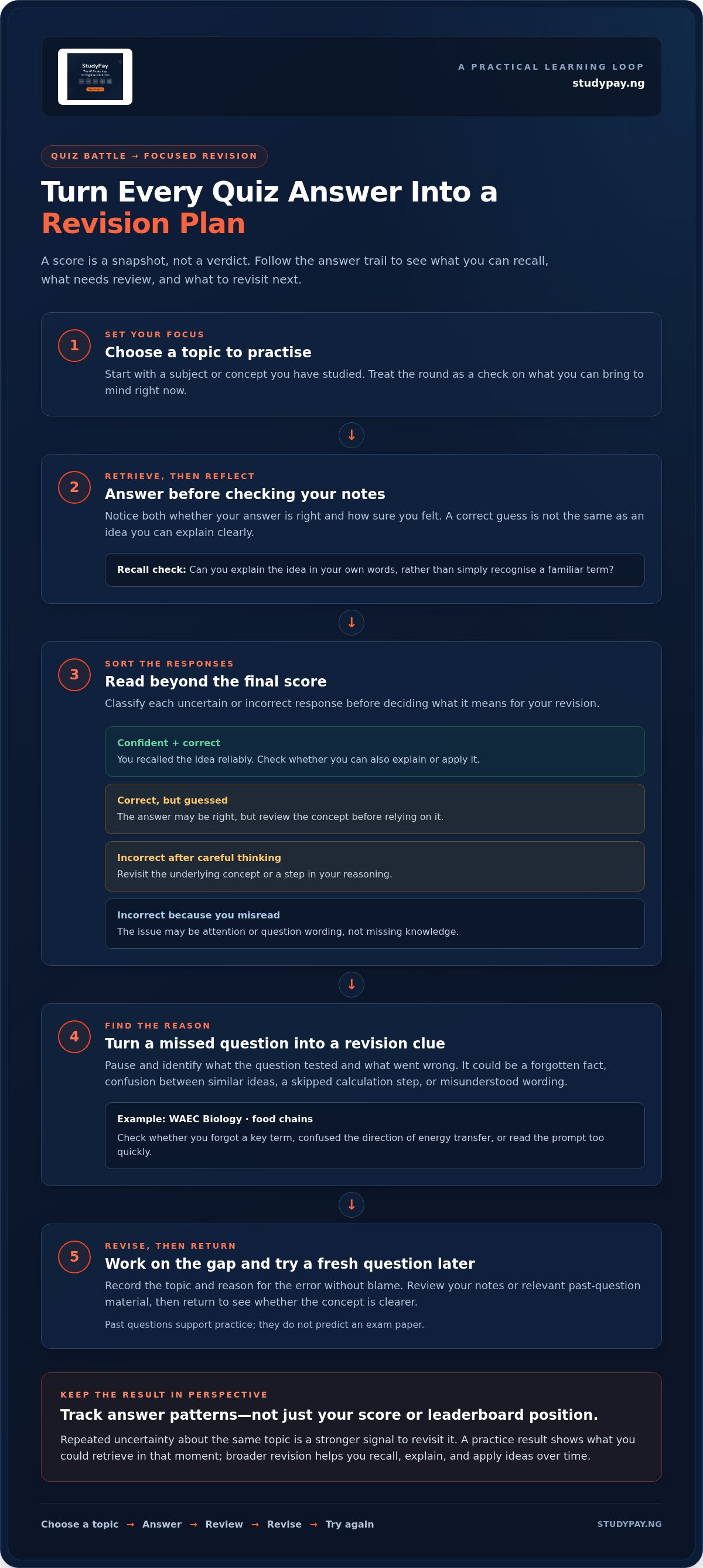
A practical routine for learning from an online quiz battle
Make each session do more than produce a score. A simple routine can turn an online quiz battle for students into a focused cycle of practice and revision. Choose one topic, answer without checking your notes, review what felt difficult, and use what you learn to guide your next study session.
Before the battle: choose a focused learning goal
Pick a subject area or specific topic instead of trying to cover everything at once. Decide what you want to check: quick recall of key facts, understanding of an idea, or topics that need more work. Make an honest attempt without opening your notes as you answer. The goal is useful feedback, not a perfect result.
- Choose a topic. Narrow your focus to a particular Mathematics method or a Biology concept you’ve recently studied.
- Attempt the questions. Answer from memory first. Note any response you guessed or felt unsure about, even if it turns out to be correct.
- Review the errors. For each missed answer, work out whether the content was unfamiliar, the idea was misunderstood, or you made a possible slip.
- Revise the gap. Return to the relevant class notes or suitable past-question material. Focus on the concept or step behind the answer instead of memorising a letter or option.
- Retry with care. Attempt related questions after reviewing. Check whether you can explain your reasoning, not only whether your score changes.
Keep a short learning log. Record the topic, what confused you, and what you reviewed. A note such as “revisit the steps for solving simultaneous equations” gives you a clearer next action than a score alone. Add concepts you answered correctly but guessed, so uncertainty remains part of your revision plan.
After the battle: review, revise, and try again
Use your notes to spot patterns across practice, rather than judging yourself by one attempt. If the same concept keeps causing hesitation, give it more attention. If you got an answer wrong because you rushed or misread the question, practise checking the wording. When you retry, use a fresh question or explain the concept in your own words to check whether your understanding is becoming more secure.
Choose a topic, attempt questions, review what challenged you, revise the gap, and retry to check your learning. This turns a quiz session into a practical revision loop. Build yours with StudyPay’s academic quiz battles, then use the questions that challenge you to guide your follow-up study.
How StudyPay quiz battles fit into a student's revision plan
StudyPay offers academic quiz battles and competitions for primary, secondary, and tertiary students in Nigeria. An online quiz battle for students adds an active way to practise, but it works best as one part of a revision plan alongside class notes, independent study, and exam practice.
Think of a quiz as a checkpoint, not the whole journey. It can help you test what you recall and spot topics that deserve another look. Use those clues to guide your study instead of treating participation or a result as proof that you’ve fully covered a subject.
Pair a quiz challenge with focused study resources
Connect the topic you practised to a useful follow-up. If a question leaves you unsure about a concept, revisit the relevant notes or use suitable past-question material to work through the subject more carefully. StudyPay provides curated study resources and past exam questions for students to use as part of their revision.
Keep the sequence simple: practise, identify what needs attention, review the learning material, then practise again. After a quiz on a topic you’re studying, write down any concept you found difficult. Review it in your notes, attempt relevant past questions, and return to practice to see whether you can now answer with clearer reasoning. That follow-through turns a quiz into purposeful revision.
A battle doesn’t replace reading, working through examples, or preparing for the demands of an examination. It gives you another way to engage with academic questions and notice where your next effort may be useful. Balance it with the study methods your subjects require.
Join for practice, progress, and academic engagement
Bring a learning goal to each challenge. You might aim to practise a subject, participate consistently, or identify a concept to review afterwards. A leaderboard can add a competitive spark, but rank alone doesn’t show everything you understand. Focus on progress in explaining ideas and recognising what still needs work.
StudyPay links participation and quiz performance with academic recognition and platform rewards. These are part of student engagement, not a promise of a particular reward, grade, or exam result. Keep learning at the centre: take part ready to try, reflect on what the questions reveal, and carry those insights into your revision.
Use StudyPay quiz battles as a practical starting point, then build on the experience with focused study resources and your own review. Explore StudyPay quiz battles as one way to bring academic practice into your revision routine.
Make your next study session count
Make your next study session a small experiment. Choose a topic you want to feel more confident about, then approach each question with curiosity. The win isn’t only a higher score. It’s being able to explain your thinking more clearly and choose what to learn next.
An online quiz battle for students can encourage you to keep practising, especially when you focus on your own progress rather than comparing every result with someone else’s. Give yourself room to improve over time. A challenging round can point towards a question to explore and an opportunity to strengthen your understanding.
Bring a learning-first mindset to your next challenge. Explore StudyPay quiz battles, then carry what you learn into your wider revision. Keep showing up, stay curious, and let each step move you closer to feeling prepared.
Frequently Asked Questions
Can an online quiz battle help students prepare for WAEC or JAMB?
Yes. An online quiz battle for students can add practice recalling subject knowledge for WAEC or JAMB preparation. It can’t predict exam questions or replace studying the syllabus and practising with exam-style materials. After revising a Chemistry topic, for example, use a quiz to check what you remember, then compare any uncertainties with your notes and relevant past questions. Treat the result as one input to your preparation.
Are quiz battles useful if I get many answers wrong?
Yes. Wrong answers can help you identify which parts of a subject deserve attention, especially if you group them by topic instead of focusing only on the total. Check whether the errors cluster around one idea or have different causes, such as an unfamiliar term or a skipped calculation step. Choose one pattern to address first. Mistakes are information for your study plan, not a label of your ability.
Do online quiz battles test understanding or just speed?
They can test recall, but how much they reveal about understanding depends on the questions and the pace of the activity. A quick correct choice may not show whether you can explain the idea or use it in a new situation. After answering, state why your choice makes sense or solve a related problem without looking at the answer. That extra check helps you assess more than how quickly you responded.
Should I use quiz battles instead of past questions?
No. Use them for different kinds of practice. A quiz battle can make it engaging to check what you remember, while past questions let you work directly with exam-style material. After a battle highlights a difficult topic, practise relevant past questions and review how each problem is set out. Don’t assume quiz questions will match an upcoming paper. A balanced plan makes room for both formats.
How often should students take part in online quiz battles?
There isn’t one ideal frequency for every student. Fit a quiz into your revision plan when it can help you check a topic, rather than joining so often that you skip careful study. You might practise after completing a section of your notes, then use the result to decide what to review before another attempt. If a quiz leaves you rushing through revision, slow down and give the subject more study time.
Can quiz battle rewards guarantee academic success or cash?
No. Rewards can’t guarantee academic success, a particular grade, or cash. StudyPay connects engagement-based rewards with participation and quiz performance, but a reward isn’t a promise of a specific outcome. Keep your reason for taking part grounded in learning: use the experience to practise, challenge yourself, and stay engaged with your studies. Your preparation still depends on the work you put into understanding and revising your subjects.
What should I do after finishing a quiz battle?
Before starting another activity, note what you want to remember from the one you’ve completed. Write down a topic that needs more attention and a question or idea you want to understand better. Then choose a useful next step, such as checking a class note, practising a related past question, or explaining the concept in your own words. This turns participation into a clear action for your next study session.
