
Searching for an academic quiz competition Nigeria students can enter is only the first step. Some contests are designed for individual learners, while others require a school team or are limited to particular year groups. Their rounds, subjects and rules can differ just as much.
It’s natural to wonder whether a competition is a formal academic contest or a casual online quiz. The organiser’s guidelines clarify what participation involves. Read them early to understand eligibility, registration, timing, permitted resources and how answers are scored.
This guide explains common competition formats in Nigeria, who may organise them and what to look for in the rules before signing up or preparing. You’ll also find a practical way to revise, strengthen subject knowledge and build confidence without making preparation overwhelming. Past questions and quiz practice, including StudyPay.ng quiz battles, can help you identify knowledge gaps and focus your revision.
Key Takeaways
- Use the organiser’s published rules, not the word “quiz,” to understand what an academic quiz competition in Nigeria involves.
- Check eligibility, subjects, individual or team format, stages and participation terms before deciding whether a contest suits you.
- Read the guidelines carefully and plan around the competition’s specific requirements before registering.
- Practise consistently and review mistakes to identify topics that need more attention.
- Use quiz battles, past questions and curated study resources to practise, while treating them as preparation rather than a promise of results.
What Is an Academic Quiz Competition in Nigeria?
An academic quiz competition is a structured contest in which eligible students answer questions on specified subjects or academic areas under rules set by an organiser.
That structure distinguishes a formal contest from a classroom revision quiz, which a teacher may use to check learning, or an informal online game played mainly for fun. A competition sets out who can participate, how questions are answered and how contestants progress or are assessed. Its scope might be limited to one school or include learners from multiple schools.
There’s no single format for an academic quiz competition Nigeria students might enter. One event may focus on Mathematics or science, while another covers several subjects or general knowledge. Students might compete individually or represent a school as a team. Rounds, eligibility and recognition also depend on the organiser, so don’t assume one event’s rules apply to another.
Some contests use quiz-bowl elements, such as responding to academic questions in structured rounds, but the details vary. The general overview of quiz bowl competitions introduces the format and its variations. For a specific event, use the organiser’s own guidelines to understand how participation works.
Who organises academic quiz competitions?
Possible organisers include schools, education authorities, universities, foundations, companies and other educational organisations. For example, the 2026 Roseline Etuokwu Sigma National Secondary School Quiz Competition was organised by Sigma Club at the University of Ibadan. The United Organisation for Education and Sports Development organised the 2026 UOESD National Quiz Competition, while Sterling has run a Maths Quiz Competition. These past editions illustrate different types of organisers, not current registration opportunities.
The organiser determines a contest’s scope and rules. A school may hold a challenge for its own learners, while a university club, foundation or company may arrange an event for students from several schools. When you find an academic quiz competition Nigeria learners are discussing, identify its organiser and read the event information to understand what it covers and how it works.
Who can take part?
Eligibility can depend on school level, year group, subject or entry format. An event may be aimed at secondary students in a specified class, require contestants to represent their school or invite team entries. Another competition may suit a different education level. Don’t assume you can enter individually or that every event is open to all students.
Before registering or beginning focused preparation, read the current official guidelines. Check which learners are eligible, whether school or team representation is required, what subjects are covered and how to enter. This helps you choose an opportunity that fits and prepare for its actual requirements.
How Academic Quiz Competition Formats Work
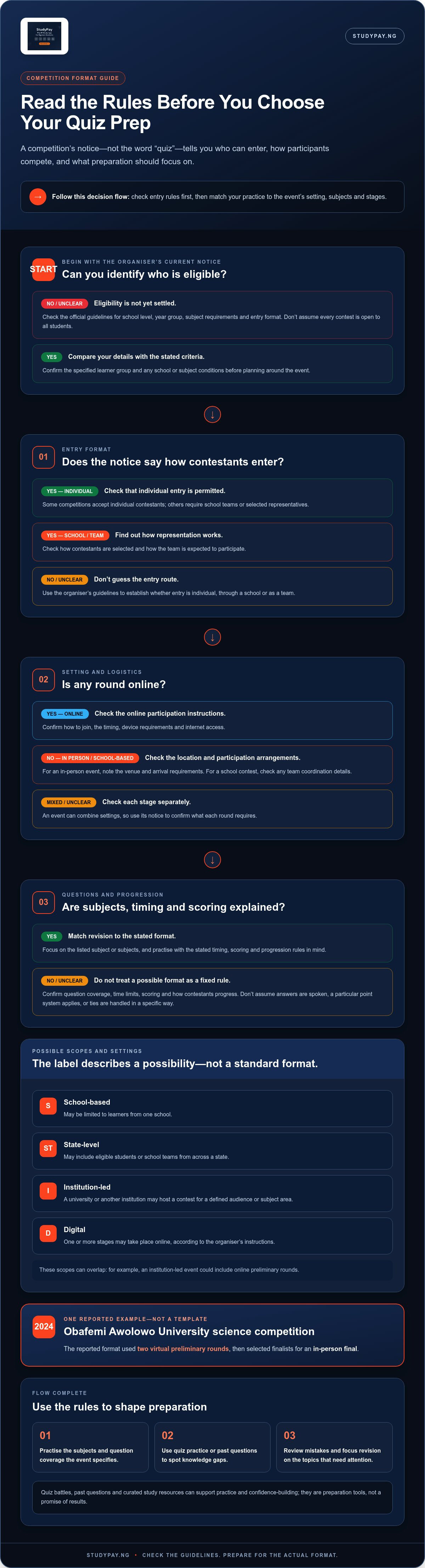
There isn’t one format for an academic quiz competition Nigeria students might consider. A school may run a contest for its own learners, while an education authority could organise one for schools across a state. Universities and other institutions may host subject-focused events, and some organisers use digital rounds. These are possible approaches, not fixed national categories.
Entry requirements vary too. One competition may accept individual contestants; another may require school teams or selected representatives. An event might include screening, timed question rounds and a final, but that sequence isn’t standard. When comparing an academic quiz competition in Nigeria, use its current guidelines to find out who can enter, how participants compete and which stages are planned.
Here are some common possibilities to look for in an event notice:
- School-based: The contest may be limited to learners from one school.
- State-level: Eligible students or school teams may participate from across a state.
- Institution-led: A university or another institution may organise a contest for a defined audience or subject area.
- Digital: One or more stages may take place online, following the organiser’s participation instructions.
These labels describe possible scope or setting, not guaranteed formats. A university-led event, for example, could include online preliminary rounds. The event notice should clarify whether you enter alone or through a school, what you need to participate and whether its stages combine different formats.
What can happen in a competition round?
Questions may focus on one subject or cover several, and the organiser may set a time limit. Some events screen entries before selecting contestants for later rounds or a final. The 2024 science competition reported by Obafemi Awolowo University used two virtual preliminary rounds before selecting finalists for an in-person final. That example shows one possible progression, not a template for every contest.
Scoring and advancement rules differ as well. Don’t assume that answers are spoken, that a particular point system applies or that ties are handled in a specific way. Check the guidelines for question coverage, timing, scoring and progression so your practice reflects the event’s actual structure.
Online, school-based or in-person: what changes?
The setting affects what you need to prepare. For an online round, check the instructions for joining, timing, devices and internet access. For an in-person event, note the venue and arrival requirements. A school-based contest may involve team coordination, so find out how representatives are selected and how the team is expected to participate.
Digital events don’t all follow the same process, and an online qualifier doesn’t mean the entire competition is virtual. Read the organiser’s latest instructions, then practise the relevant question style. For additional quiz practice, you can practise with StudyPay quiz battles as part of your preparation.
How to Judge Whether a Quiz Competition Is a Good Fit
A competition’s title can sound impressive, but it doesn’t tell you whether you’re eligible or what taking part involves. To assess an academic quiz competition in Nigeria, focus on clear rules, specific participation requirements and an identifiable organiser. A good fit is one whose conditions you understand and can meet, not simply one with a familiar name or appealing reward.
Use this comparison table to assess key details before committing time to registration or preparation:
| What to check | Questions to answer |
|---|---|
| Organiser | Who is responsible for running the event, and where are its official details published? |
| Eligible learners | Which school levels, year groups or participants can enter? |
| Subjects | Which subjects or academic areas are covered? |
| Format | Is entry individual or through a school team? Is participation online or in person? |
| Stages | Are there screening rounds, qualifiers or a final, and how do participants progress? |
| Published terms | Are registration steps, deadlines, scoring rules and any stated rewards explained? |
Which rules should students read first?
Start with class or age eligibility, entry type, registration steps and deadlines. Then check the subjects, scoring method, tie-break rules, disqualification conditions and participation requirements. If you’re entering through your school, look for instructions about school representation or team selection. Use the organiser’s current official guidelines rather than an old repost, word of mouth or assumptions based on another event.
Pay particular attention to conditions that affect your ability to participate, such as required documents, event dates or instructions for an online round. If a detail isn’t clear in the published terms, don’t guess. The competition rules should explain what participants need to do and what happens at each stage.
What signals a clear and credible event?
Look for an identifiable organiser, accessible guidelines and consistent details across its official channels. Information about registration, communication and participant data should be understandable. If rewards are mentioned, check what the organiser says about eligibility and how they’re awarded. A page or familiar branding alone doesn’t establish that an event is suitable or trustworthy, so assess the published information as a whole.
Recognition and rewards vary by competition. Some may offer certificates or other forms of recognition; others may describe prizes in their terms. An advertised reward doesn’t guarantee that you’ll receive an award or achieve a particular result. Prioritise whether the event is clear, relevant to your learning goals and manageable for you.
Save this checklist: confirm the organiser, eligibility, subjects, entry format, stages, deadlines, scoring, participation conditions and any stated rewards before deciding to join.
How to Prepare for an Academic Quiz Competition
Strong preparation starts with the competition’s actual requirements, not a guess about what might come up. Use this sequence to turn the guidelines into a focused plan. It works whether you’re preparing alone or coordinating with school teammates.
- Read the rules. Note the eligible subjects, stages, question style, participation requirements and any stated time limits. Keep the official guidelines nearby as you prepare.
- Map the subjects. Break each subject into manageable topics. Mark areas you know well, topics that need review and anything you’re unsure how to approach.
- Practise actively. Use class notes, textbooks and relevant past questions to test recall instead of only rereading material. Try question formats similar to those described in the competition rules.
- Review errors. Record incorrect answers and the reason for each mistake, such as a forgotten fact, a misunderstanding or a rushed response. Revisit those topics before moving on.
- Plan participation. Note dates and instructions, then prepare for the stated format. This may mean coordinating with teammates, arranging travel or preparing a device for an online round.
Build a focused revision routine
Keep practice consistent rather than trying to cover everything in a last-minute cram. Choose a topic for each session, answer questions on it, then check what you missed. Past examination questions can support revision, but use them alongside textbooks and class notes, and follow the competition’s subject list as your guide. Track recurring errors so you spend time on weak areas instead of repeating only familiar questions.
Reviewing wrong answers shows you which concepts need attention, so you can target revision instead of practising only what you already know.
Practise the conditions you will face
Use timed question sets if the published format includes timing. Practising against a clock can help you get familiar with the pace. If the rules include oral answers or team rounds, practise explaining your reasoning clearly and listening to teammates. For online participation, follow the event’s device and internet instructions. For an in-person round, plan around its venue and travel details.
You don’t need to feel fully confident before you begin. Each practice round can show you what to strengthen next. Keep a simple record of topics reviewed, questions attempted and errors to revisit, then adjust your plan as the event approaches. Aim for steady progress, not a promised score.
Ready to test your knowledge with interactive practice? Try StudyPay quiz battles and use each attempt to identify topics you may want to review.
Use StudyPay to Keep Practising and Take Your Next Step
Preparation doesn’t have to stop after one practice session. StudyPay quiz battles give you an interactive way to test what you know, stay engaged with learning and notice which topics could use another look. Treat each attempt as feedback, not a prediction of how you’ll perform in an official contest.
Turn practice into steady progress
After a quiz, note which answers felt secure and which ones you guessed or missed. Identify the subject or topic behind each gap, then revisit it using relevant revision material. StudyPay’s past examination questions and curated study resources can support that review alongside your class notes and textbooks.
Keep the goal simple: practise consistently, learn from errors and return to challenging topics. You don’t need to chase a ranking or expect a particular reward to make the effort worthwhile. Building familiarity with questions and strengthening subject knowledge are useful steps in preparing for an academic quiz competition in Nigeria, though practice resources can’t guarantee entry, prizes or results.
StudyPay’s WhatsApp tools provide competition schedule updates and study alerts. These can help you stay aware of learning activity and upcoming schedules while you continue your revision. Always rely on the specific organiser’s official guidelines for entry requirements, competition dates and rules.
Choose your next learning step
Before entering an event, return to its current official information and make sure you understand who can participate, how entry works and what the competition expects. Then choose a manageable study step: review a topic, answer a few practice questions or revisit an error from your last quiz. Small, steady actions keep your preparation moving without turning it into last-minute pressure.
Ready to keep your knowledge active? Explore StudyPay quiz battles and study resources, and take your next practice session at your own pace.
Make Your Next Step Count
Your first competition doesn’t need to feel like a test of whether you’re already perfect. Treat it as a chance to challenge yourself, discover what you know and keep learning. Useful preparation is something you can return to: a question that makes you think, a topic worth revisiting or a small goal for your next study session.
Whether you’re exploring an academic quiz competition Nigeria for the first time or building on past experience, progress comes from showing up with curiosity and a willingness to learn. Let each practice attempt guide your next move. Confidence grows through effort, one question at a time.
Ready to put that mindset into action? Explore StudyPay quiz battles and study resources and choose a practice step that fits your learning goals. Keep going at your own pace, stay curious and give yourself room to improve. Each practice session can help you build momentum.
Frequently Asked Questions
What is an academic quiz competition?
It’s an organised contest where students answer questions on academic subjects, such as Mathematics, English or science. Unlike a quick revision activity used by a teacher, a competition has participation rules and a defined way to determine progress or recognition. For example, a science-focused event may test concepts from several branches of science, while a general quiz may cover a wider mix of subjects. Check the event details to see what knowledge it tests.
Who can participate in academic quiz competitions in Nigeria?
Eligibility depends on the event. An academic quiz competition in Nigeria may target a particular school level or year group, while another contest may accept school teams or focus on one subject. Don’t assume that being a student is enough to enter. Check the current notice for age or class limits, school representation requirements and whether a teacher or school must submit the entry on your behalf.
Are academic quiz competitions in Nigeria online or in person?
They can be online, in person or a mix of both. Some competitions use a digital qualifier before an in-person final, while others hold activities in a school or at a specified venue. Before committing, consider what participation requires: a device and internet access for an online round, or travel arrangements for an in-person event. Follow the organiser’s latest instructions, since a previous edition’s setup may not apply.
How do I prepare for an academic quiz competition?
Start by choosing a topic from the competition’s subject list and testing what you can recall without looking at your notes. Check your answers, write down anything you need to revisit, then review it using a textbook or class notes. Repeat with another topic in a later session. If you’re preparing with classmates, take turns asking questions and explaining answers so practice includes both recall and clear communication.
Do academic quiz competitions give prizes or certificates?
Some competitions offer certificates, trophies, cash prizes or other forms of recognition, while others may focus on participation or academic experience. The organiser sets the terms, including who qualifies for a reward and whether it goes to an individual or a school. Read the current event notice for details, and treat any prize as a possible outcome rather than assuming every participant will receive one.
Can I practise for a competition without a private tutor?
Yes. Independent revision can be useful: choose a topic, answer practice questions and check errors against your notes or a textbook. StudyPay offers quiz battles to test your knowledge, along with past examination questions and curated study resources for revision. Its WhatsApp updates share competition schedules and study alerts. These tools support practice, but they don’t replace the official rules for a competition you plan to enter.

